
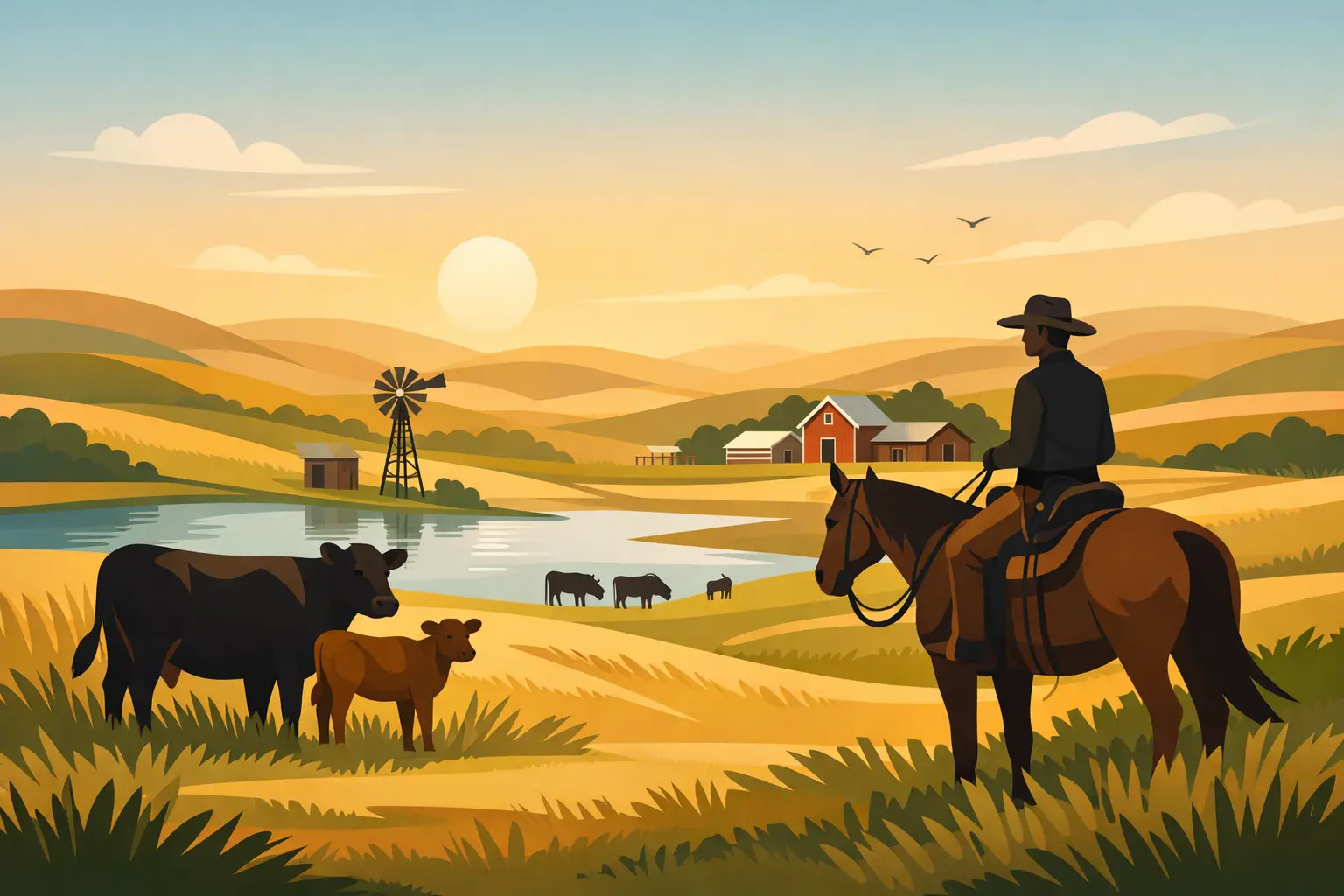
Before sunrise, the Sandhills do not announce themselves with noise. They open slowly – wind over grass, horses shifting in the dark, a gate chain rattling, cattle moving as a day’s work begins. A Nebraska Sandhills ranch documentary has to understand that rhythm before it can tell the truth. If it rushes in looking for spectacle, it misses the thing that matters most: this country is shaped by patience, memory, labor, and people who know how to read land that outsiders often fail to see.
That is why this kind of film matters. The Nebraska Sandhills are one of the most distinctive landscapes in the United States, but the deeper story is not only geographical. It is human. A ranch documentary set here carries a responsibility to show what life actually feels like on working ground – the humor around hardship, the pressure of weather, the tenderness required in livestock care, and the quiet way family history lives in daily chores.
What a Nebraska Sandhills ranch documentary should get right
The strongest documentaries about ranch life do not treat agriculture as background scenery. They understand that ranching is not an abstract idea or a lifestyle brand. It is work tied to seasons, markets, water, grass, fences, calving, and decisions that have real consequences. In the Sandhills, that work also exists inside a landscape that can look soft from a distance and prove unforgiving up close.
A truthful film has to hold both realities at once. The country is beautiful, but beauty is not the whole story. Wind can wear a person down. Drought can tighten every conversation. A bad storm can erase sleep for days. Even so, there is deep satisfaction in competent work, in cattle gathered well, in hay put up at the right time, in seeing another generation learn what stewardship asks of them.
That balance is where many portrayals of rural America fall short. They either romanticize ranch life until it loses its weight, or they flatten it into hardship alone. Neither approach respects the people living it. Ranch families know that joy and strain usually ride together. A good documentary leaves room for both.
Why the Sandhills are more than a backdrop
The Nebraska Sandhills are not just visually striking. They shape the entire character of ranch life. Their rolling grass-covered dunes, fragile soils, and vast distances have produced a kind of cattle country that depends on careful management and long memory. People who ranch there are not simply working on the land. They are working with its limits.
That distinction matters. Stewardship in the Sandhills is not a slogan. It shows up in grazing decisions, water use, animal care, and whether a family can think in decades instead of only in the next sale barn cycle. The land teaches restraint. It rewards observation. It punishes arrogance.
For viewers who did not grow up around agriculture, this is often the revelation. A ranch is not a static postcard. It is a living system where weather, grass, animals, economics, and family history all press on each other at once. When a documentary captures that complexity, it becomes more than regional storytelling. It becomes a clearer way of understanding American life itself.
The people make the story
No Nebraska Sandhills ranch documentary earns trust by relying only on scenery. The real power comes from the people on screen and the way they are allowed to speak for themselves. If a film listens closely, ranchers do not need to be dressed up as symbols of toughness or nostalgia. Their authority comes naturally through what they know, how they work, and what they are willing to carry.
Multigenerational ranch stories carry particular emotional weight because they are full of both continuity and change. One generation may be thinking about succession. Another is trying to prove itself. Older family members may hold knowledge that cannot be found in any manual – when a pasture turns, how cattle handle a certain draw, what a hard winter taught them 30 years ago. Younger family members may be balancing loyalty to home with the pressure of modern economics and a changing world.
That tension is not a flaw in the story. It is the story. Ranch life is often described in broad terms like tradition, but tradition only stays alive when real people keep choosing it, adapting it, and paying the cost of it. A documentary worth watching shows those choices clearly.
Honesty matters more than polish
There is a temptation in nonfiction filmmaking to tidy everything up. But ranch life does not arrive in neat talking points. It comes with dust on the windshield, tired faces at the end of a long day, and conversations that reveal as much in pauses as in words. The best films understand that honesty is more moving than polish.
That does not mean rough filmmaking. Craft still matters. Cinematography, sound, pacing, and editing all shape whether a viewer feels present on the ranch or kept at a distance. But artistic care should serve the truth, not overpower it. A gate swinging shut at dusk can say more than a narrator explaining rural values. A hand on a horse’s neck can reveal more about character than a page of exposition.
For audiences inside agriculture, this kind of honesty is a form of respect. People who know ranch life can tell when a film is borrowing the image without understanding the reality. For audiences outside it, honesty is what breaks stereotype. It invites them to see ranching not as a political talking point or a fantasy, but as a human life shaped by responsibility.
What outsiders often learn from a ranch documentary
Many viewers come to a film about the Sandhills expecting open country and cattle work. They may not expect the emotional depth. They may not realize how much ranching depends on care – care for calves, for horses, for grass, for family members, for the future of the place itself.
A strong documentary can quietly change the way people think about food, labor, and rural communities. It can show that the work behind beef production is not faceless. It is intimate and physical. It involves judgment, skill, sacrifice, and long hours that rarely fit simple narratives about agriculture.
At the same time, a film should not pretend every ranch story stands for every ranch family. Conditions vary. Economics vary. Personal histories vary. One operation may be thriving while another is under severe pressure. One family may see continuity ahead, while another is worried about whether the next generation can afford to stay. The value of documentary is not that it speaks for everyone. It is that it tells one story truthfully enough to illuminate many others.
Why this story resonates beyond Nebraska
The reason a film like Ocean of Grass can stay with people is that its subject is local, but its emotional reach is much wider. Anyone who has cared for a place, worried about passing something on, or tried to live up to a family legacy can recognize themselves in a Sandhills ranch story.
That is especially true now, when so much public conversation about rural America feels either patronizing or performative. A careful documentary offers another way. It says: look closely, listen longer, and let people be as complicated, funny, disciplined, and vulnerable as they really are. That approach does not reduce the ranch to a symbol. It lets the ranch remain a home, a workplace, and a test of character.
For Nebraska viewers, there is also something deeper at stake. Representation matters when it is this rare and this true. To see the Sandhills treated with seriousness and affection can feel like recognition. Not flattery. Recognition. That difference is important.
The lasting value of a Nebraska Sandhills ranch documentary
A documentary set in the Sandhills can preserve more than images. It can preserve voice, gesture, knowledge, and a way of looking at the world that is increasingly easy to overlook. Film cannot stop change, and it should not pretend to. Ranch life has always involved adaptation. But documentary can bear witness. It can say this work existed, these people mattered, this land asked something of them, and they answered.
That is what gives the best ranch films their staying power. They are not only about cattle or country or weather, though all of those matter. They are about what it means to belong to a place and remain answerable to it.
If a viewer finishes a Nebraska Sandhills ranch documentary with a stronger sense of respect – for the land, for the labor, and for the families who keep showing up to do the work – then the film has done something worthwhile that lasts beyond the final frame.
